ABMESDRA Membangun Peradaban melalui Ilmu dan Karya Tulis




SINOPSIS
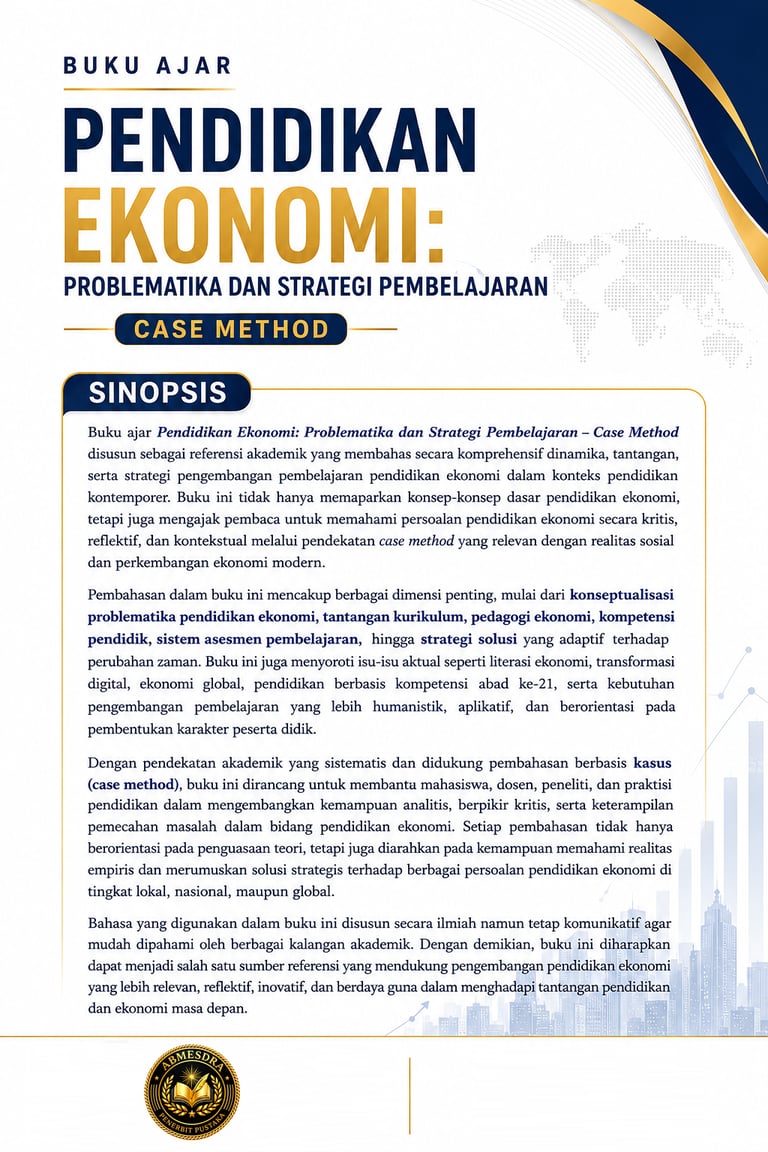
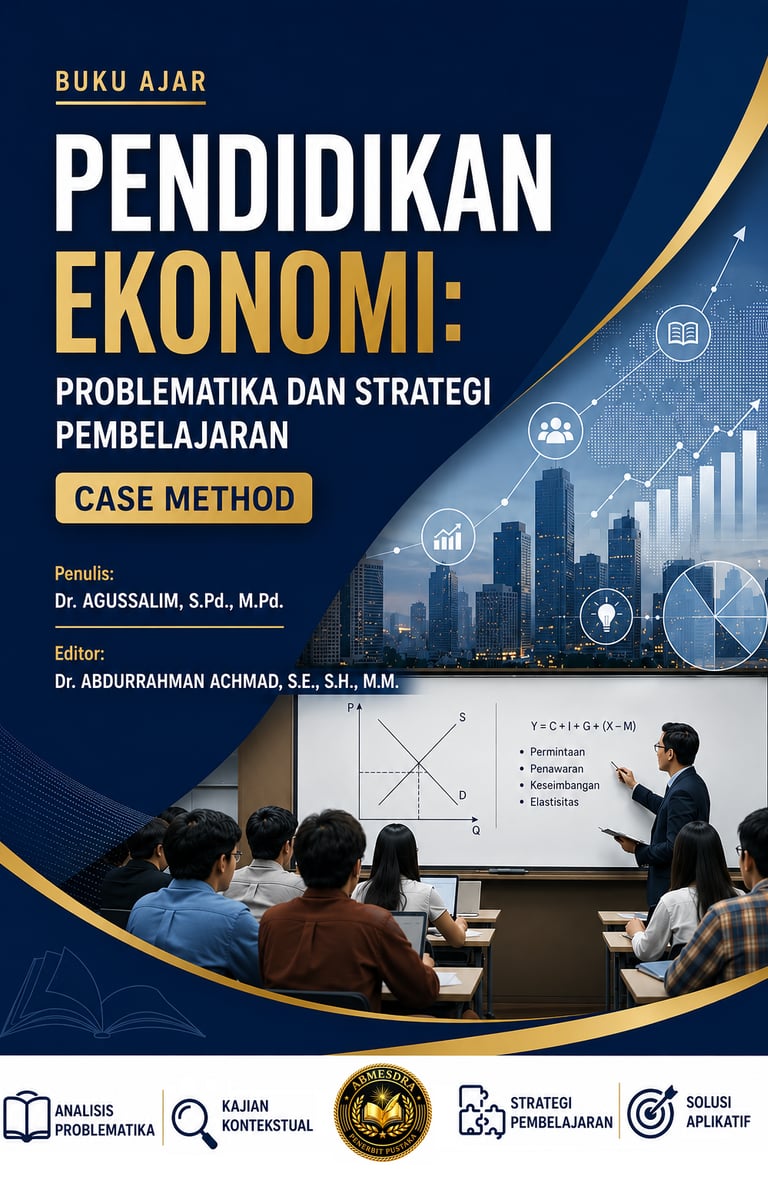
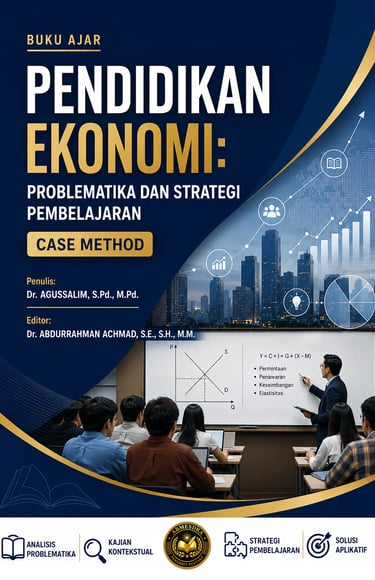
Buku ajar Pendidikan Ekonomi: Problematika dan Strategi Pembelajaran – Case Method disusun sebagai referensi akademik yang membahas secara komprehensif dinamika, tantangan, serta strategi pengembangan pembelajaran pendidikan ekonomi dalam konteks pendidikan kontemporer. Buku ini tidak hanya memaparkan konsep-konsep dasar pendidikan ekonomi, tetapi juga mengajak pembaca untuk memahami persoalan pendidikan ekonomi secara kritis, reflektif, dan kontekstual melalui pendekatan case method yang relevan dengan realitas sosial dan perkembangan ekonomi modern.
Pembahasan dalam buku ini mencakup berbagai dimensi penting, mulai dari konseptualisasi problematika pendidikan ekonomi, tantangan kurikulum, pedagogi ekonomi, kompetensi pendidik, sistem asesmen pembelajaran, hingga strategi solusi yang adaptif terhadap perubahan zaman. Buku ini juga menyoroti isu-isu aktual seperti literasi ekonomi, transformasi digital, ekonomi global, pendidikan berbasis kompetensi abad ke-21, serta kebutuhan pengembangan pembelajaran yang lebih humanistik, aplikatif, dan berorientasi pada pembentukan karakter peserta didik.
Dengan pendekatan akademik yang sistematis dan didukung pembahasan berbasis kasus (case method), buku ini dirancang untuk membantu mahasiswa, dosen, peneliti, dan praktisi pendidikan dalam mengembangkan kemampuan analitis, berpikir kritis, serta keterampilan pemecahan masalah dalam bidang pendidikan ekonomi. Setiap pembahasan tidak hanya berorientasi pada penguasaan teori, tetapi juga diarahkan pada kemampuan memahami realitas empiris dan merumuskan solusi strategis terhadap berbagai persoalan pendidikan ekonomi di tingkat lokal, nasional, maupun global.
Bahasa yang digunakan dalam buku ini disusun secara ilmiah namun tetap komunikatif agar mudah dipahami oleh berbagai kalangan akademik. Dengan demikian, buku ini diharapkan dapat menjadi salah satu sumber referensi yang mendukung pengembangan pendidikan ekonomi yang lebih relevan, reflektif, inovatif, dan berdaya guna dalam menghadapi tantangan pendidikan dan ekonomi masa depan.
Ukuran Buku : 21 cm x 29.7 cm
Jumlah Halaman : 91 Halaman
ISBN : dalam proses
Katalog Dalam Terbitan (KDT) : dalam proses
DAFTAR PUSTAKA
Acemoglu, D. (2009). Introduction to modern economic growth. Princeton University Press. https://doi.org/10.1515/9781400835775
Acemoglu, D., & Restrepo, P. (2020). Robots and jobs: Evidence from US labor markets. Journal of Political Economy, 128(6), 2188–2244. https://doi.org/10.1086/705716
Agussalim, Said, S., Fitriani, & Mursyid, F. T. (2024). Pancasila economic and its implications in economic learning. IJWEPS (International Journal Wetlands Public Services), 1(1), 22–29. https://qjurnal.my.id/index.php/IJWEPS/%0APANCASILA
Agussalim, Widjaja, S. U. M., Haryono, A., & Wahyono, H. (2021). Pancasila economic character literacy program for high school students. 14(1).
Akerlof, G. A., & Shiller, R. J. (2020). Narrative economics: How stories go viral and drive major economic events. American Economic Review, 110(4), 967–1004. https://doi.org/10.1257/aer.110.4.967
American Educational Research Association, American Psychological Association, & National Council on Measurement in Education. (2014). Standards for educational and psychological testing. American Educational Research Association.
Anderson, K., & Smith, P. (2024). Inquiry-based learning in economics education: The Australian experience. Journal of Economic Education, 55(1), 45–62. https://doi.org/10.1080/00220485.2024.1234567
Anderson, L. W., & Krathwohl, D. R. (Eds.). (2001). A taxonomy for learning, teaching, and assessing: A revision of Bloom’s taxonomy of educational objectives. Longman.
Anderson, M., & Taylor, R. (2023). Teacher professional development in economic education: A comprehensive framework. Teaching and Teacher Education, 125, 104089. https://doi.org/10.1016/j.tate.2023.104089
Andriani, S., & Budiman, A. (2023). Digital economy and education transformation in Indonesia: Challenges and opportunities. Asian Journal of Distance Education, 18(2), 156–174. https://doi.org/10.5281/zenodo.8234561
Anggraini, R., & Budiman, A. (2023). The impact of design thinking-based economics learning on creativity, problem-solving skills, and entrepreneurial intention. Journal of Economics Education Innovation, 12(2), 145–162.
Angrist, J. D., & Pischke, J. S. (2020). Empirical strategies in economics: Illuminating the path from cause to effect. Journal of Economic Perspectives, 34(2), 145–160. https://doi.org/10.1257/jep.34.2.145
Apergis, N., & Rezitis, A. (2018). Financial literacy and economic education: A systematic literature review. Economics of Education Review, 67, 156–173. https://doi.org/10.1016/j.econedurev.2018.09.008
Apple, M. W. (2019). Ideology and curriculum (4th ed.). Routledge. https://doi.org/10.4324/9780429490645
Aprea, C., Wuttke, E., Breuer, K., Koh, N. K., Davies, P., Greimel-Fuhrmann, B., & Lopus, J. S. (Eds.). (2016). International handbook of financial literacy. Springer. https://doi.org/10.1007/978-981-10-0360-8
Athey, S., & Imbens, G. W. (2019). Machine learning methods that economists should know about. Annual Review of Economics, 11(1), 685–725. https://doi.org/10.1146/annurev-economics-080217-053433
Australian Curriculum, Assessment and Reporting Authority. (2017). Economics and business curriculum. ACARA.
Avalos, B. (2021). Teacher professional development in teaching and teacher education over ten years. Teaching and Teacher Education, 100, 103190. https://doi.org/10.1016/j.tate.2021.103190
Baldwin, R. (2019). The globotics upheaval: Globalization, robotics, and the future of work. Oxford Review of Economic Policy, 35(3), 447–460. https://doi.org/10.1093/oxrep/grz006
Ball, D. L., Thames, M. H., & Phelps, G. (2019). Content knowledge for teaching: What makes it special? Journal of Teacher Education, 70(5), 389–407. https://doi.org/10.1177/0022487119841434
Beck, U. (2018). Economic plurality and the need for curriculum reform. International Review of Economics Education, 29, 40–52. https://doi.org/10.1016/j.iree.2018.08.001
Becker, W. E. (2019). Teaching economics in the 21st century. Journal of Economic Perspectives, 14(1), 109–119. https://doi.org/10.1257/jep.14.1.109
Becker, W. E., & Watts, M. (2001). Teaching economics at the start of the 21st century: Still chalk-and-talk. American Economic Review, 91(2), 446–451. https://doi.org/10.1257/aer.91.2.446
Becker, W. E., & Watts, M. (2008). Teaching economics: More alternatives to chalk and talk. Edward Elgar Publishing. https://doi.org/10.4337/9781848443787
Becker, W. E., Watts, M., & Bosshardt, W. (2020). Teaching economics to undergraduates: Alternatives to chalk and talk. Journal of Economic Education, 51(2), 180–199. https://doi.org/10.1080/00220485.2020.1731386
Bell, S. (2010). Project-based learning for the 21st century: Skills for the future. The Clearing House, 83(2), 39–43. https://doi.org/10.1080/00098650903505415
Bennett, R. E. (2011). Formative assessment: A critical review. Assessment in Education: Principles, Policy & Practice, 18(1), 5–25. https://doi.org/10.1080/0969594X.2010.513678
Biggs, J., & Tang, C. (2011). Teaching for quality learning at university (4th ed.). Open University Press.
Biesta, G. (2017). The rediscovery of teaching. Routledge. https://doi.org/10.4324/9781315677747
Birdthistle, N., Hynes, B., & Fleming, P. (2007). Enterprise education programmes in secondary schools in Ireland: A multi-stakeholder perspective. Education + Training, 49(4), 265–276. https://doi.org/10.1108/00400910710754426
Bjork, C. (2005). Indonesian education: Teachers, schools, and central bureaucracy. Routledge.
Black, P., & Wiliam, D. (2018). Classroom assessment and pedagogy. Assessment in Education: Principles, Policy & Practice, 25(6), 551–575. https://doi.org/10.1080/0969594X.2018.1441807
Bloom, B. S., Engelhart, M. D., Furst, E. J., Hill, W. H., & Krathwohl, D. R. (1956). Taxonomy of educational objectives: The classification of educational goals. Handbook 1: Cognitive domain. David McKay.
Bok, D. (2006). Our underachieving colleges: A candid look at how much students learn and why they should be learning more. Princeton University Press.
Borko, H., Koellner, K., & Jacobs, J. (2019). Examining novice teacher leader facilitation of mathematics professional development. Journal of Mathematical Behavior, 33, 149–167. https://doi.org/10.1016/j.jmathb.2013.11.003
Boud, D., & Dochy, F. (2020). Assessment 2020: Seven propositions for assessment reform in higher education. Studies in Higher Education, 45(6), 1229–1242. https://doi.org/10.1080/03075079.2018.1553215
Bowles, S., & Carlin, W. (2020). What students learn in economics 101: Time for a change. Journal of Economic Literature, 58(1), 176–214. https://doi.org/10.1257/jel.20191585
Bozkurt, A., & Sharma, R. C. (2020). Emergency remote teaching in a time of global crisis due to coronavirus pandemic. Asian Journal of Distance Education, 15(1), i–vi. https://doi.org/10.5281/zenodo.3778083
Brookhart, S. M. (2018). Appropriate criteria: Key to effective rubrics. Frontiers in Education, 3, Article 22. https://doi.org/10.3389/feduc.2018.00022
Brookhart, S. M., & Chen, F. (2015). The quality and effectiveness of descriptive rubrics. Educational Review, 67(3), 343–368. https://doi.org/10.1080/00131911.2014.929565
Brown, L., & Garcia, M. (2024). Competency-based curriculum design for 21st century economic education. Curriculum Inquiry, 54(2), 201–225. https://doi.org/10.1080/03626784.2024.2156789
Brown, T. (2008). Design thinking. Harvard Business Review, 86(6), 84–92.
Brynjolfsson, E., & McAfee, A. (2014). The second machine age: Work, progress, and prosperity in a time of brilliant technologies. W. W. Norton & Company.
Calvani, A., Cartelli, A., Fini, A., & Ranieri, M. (2008). Models and instruments for assessing digital competence at school. Journal of e-Learning and Knowledge Society, 4(3), 183–193.
Campbell, J., & Moore, S. (2023). Strategic planning for educational reform: A phased implementation approach. Educational Management Administration & Leadership, 51(4), 789–810. https://doi.org/10.1177/17411432231156789
Chen, X., & Li, Y. (2023). Comparative study of economic education systems: International perspectives. International Journal of Educational Development, 98, 102745. https://doi.org/10.1016/j.ijedudev.2023.102745
Colander, D., & McGoldrick, K. (2019). The economics major as illiberal education. Journal of Economic Education, 50(1), 8–20. https://doi.org/10.1080/00220485.2018.1551100
Conejo, R., Guzmán, E., & Trella, M. (2016). The SIETTE automatic assessment environment. International Journal of Artificial Intelligence in Education, 26(1), 270–292. https://doi.org/10.1007/s40593-015-0078-4
Coyle, D. (2012). The soulful science: What economists really do and why it matters. Princeton University Press.
Creswell, J. W., & Poth, C. N. (2018). Qualitative inquiry and research design (4th ed.). Sage.
Cropley, A. J. (2016). Qualitative research methods: A practice-oriented introduction for students of psychology and education (2nd ed.). Zinātne. https://doi.org/10.13140/RG.2.1.3065.6888
Darling-Hammond, L., & Adamson, F. (Eds.). (2014). Beyond the bubble test: How performance assessments support 21st century learning. Jossey-Bass.
Darling-Hammond, L., Flook, L., Cook-Harvey, C., Barron, B., & Osher, D. (2020). Implications for educational practice of the science of learning and development. Applied Developmental Science, 24(2), 97–140. https://doi.org/10.1080/10888691.2018.1537791
Darling-Hammond, L., Hyler, M. E., & Gardner, M. (2020). Effective teacher professional development. Learning Policy Institute, 45(3), 234–259. https://doi.org/10.54300/122.311
Davies, P. (2015). Towards a framework for financial literacy in the context of democracy. Journal of Curriculum Studies, 47(2), 300–316. https://doi.org/10.1080/00220272.2014.934717
Davies, P., & Lundholm, C. (2018). Students’ understanding of socio-economic issues. Journal of Economic Education, 49(1), 60–72. https://doi.org/10.1080/00220485.2017.1407108
Davies, P., & Mangan, J. (2007). Threshold concepts and the integration of understanding in economics. Studies in Higher Education, 32(6), 711–726. https://doi.org/10.1080/03075070701685148
Davies, P., & Mangan, J. (2019). Recognising threshold concepts: An exploration of different approaches. Active Learning in Higher Education, 20(3), 247–260. https://doi.org/10.1177/1469787417731194
Davies, R., & Williams, H. (2024). Virtual reality and gamification in economics teaching: Evidence from UK schools. British Journal of Educational Technology, 55(3), 876–895. https://doi.org/10.1111/bjet.13398
Davis, J. B., & Reimann, R. (2021). The Oxford handbook of pluralist economics education. Economics Education Review, 80, 102015. https://doi.org/10.1016/j.econedurev.2020.102015
Davis, P., & Green, T. (2024). Monitoring and evaluation frameworks for education quality assurance. Assessment in Education: Principles, Policy & Practice, 31(1), 45–68. https://doi.org/10.1080/0969594X.2024.2134567
Day, C., & Sachs, J. (2019). Professional development for teachers: International perspectives. Teaching and Teacher Education, 82, 103–116. https://doi.org/10.1016/j.tate.2019.03.006
DeLuca, C., LaPointe-McEwan, D., & Luhanga, U. (2016). Teacher assessment literacy: A review of international standards and measures. Educational Assessment, Evaluation and Accountability, 28(3), 251–272. https://doi.org/10.1007/s11092-015-9233-6
Desimone, L. M., & Garet, M. S. (2019). Best practices in teacher professional development in the United States. Psychology, Society, & Education, 7(3), 252–263. https://doi.org/10.25115/psye.v7i3.1506
Earle, J., Moran, C., & Ward-Perkins, Z. (2017). The econocracy: The perils of leaving economics to the experts. Manchester University Press.
Emerson, T. L. N., & Taylor, B. A. (2004). Comparing student achievement across experimental and lecture-oriented sections of a principles of microeconomics course. Southern Economic Journal, 70(3), 672–693. https://doi.org/10.2307/4135334
Ennis, R. H. (2015). Critical thinking: A streamlined conception. In M. Davies & R. Barnett (Eds.), The Palgrave handbook of critical thinking in higher education (pp. 31–47). Palgrave Macmillan. https://doi.org/10.1057/9781137378057_2
Eshet-Alkalai, Y. (2004). Digital literacy: A conceptual framework for survival skills in the digital era. Journal of Educational Multimedia and Hypermedia, 13(1), 93–106.
European Commission. (2016). EntreComp: The entrepreneurship competence framework. Publications Office of the European Union. https://doi.org/10.2791/593884
Facione, P. A. (2020). Critical thinking: What it is and why it counts. Insight Assessment.
Fahmi, M., Maulana, A., & Yusuf, A. A. (2017). Teacher certification in Indonesia: A confusion of means and ends. Studies in Higher Education, 44(5), 935–950. https://doi.org/10.1080/03075079.2017.1404671
Fayolle, A., & Gailly, B. (2008). From craft to science: Teaching models and learning processes in entrepreneurship education. Journal of European Industrial Training, 32(7), 569–593. https://doi.org/10.1108/03090590810899838
Firmansyah, D., & Utami, R. (2024). Financial literacy intervention and behavioral change: An experimental study among Indonesian high school students. Journal of Consumer Affairs, 58(1), 234–256. https://doi.org/10.1111/joca.12567
Förster, M., Happ, R., & Molerov, D. (2015). Using the U.S. Test of Financial Literacy in Germany—Adaptation and validation. Journal of Economic Education, 46(3), 260–272. https://doi.org/10.1080/00220485.2015.1048853
Förster, M., Happ, R., Molerov, D., & Zlatkin-Troitschanskaia, O. (2018). Addressing the complexity of economic competence: Development and validation of the Test of Economic Competence (TEC). Empirische Pädagogik, 32(2), 276–296.
Freeman, S., Eddy, S. L., McDonough, M., Smith, M. K., Okoroafor, N., Jordt, H., & Wenderoth, M. P. (2019). Active learning increases student performance in science, engineering, and mathematics. Proceedings of the National Academy of Sciences, 111(23), 8410–8415. https://doi.org/10.1073/pnas.1319030111
Frey, B. S., & Whitman, E. (2020). Economics education: A global perspective. Journal of Economic Education, 51(3–4), 195–207. https://doi.org/10.1080/00220485.2020.1804507
Frey, B. S., & Whitman, G. (2020). The teaching of economics and its evaluation. Review of Behavioral Economics, 7(4), 347–361. https://doi.org/10.1561/105.00000131
Fullan, M. (2007). The new meaning of educational change (4th ed.). Teachers College Press.
Fullan, M. (2016). The new meaning of educational change (5th ed.). Teachers College Press.
Fullan, M., Quinn, J., & McEachen, J. (2020). Deep learning: Engage the world change the world. Education Sciences, 10(4), 103. https://doi.org/10.3390/educsci10040103
Gilster, P. (1997). Digital literacy. Wiley Computer Publishing.
Goffe, W. L., & Kauper, D. (2014). A survey of principles instructors: Why lecture prevails. Journal of Economic Education, 45(4), 360–375. https://doi.org/10.1080/00220485.2014.946547
Goffe, W. L., & Sosin, K. (2005). Teaching with technology: May you live in interesting times. Journal of Economic Education, 36(3), 278–291. https://doi.org/10.3200/JECE.36.3.278-291
Google, Temasek, & Bain. (2021). e-Conomy SEA 2021: Roaring 20s—The SEA digital decade. Google, Temasek, Bain & Company.
Gotch, C. M., & French, B. F. (2014). A systematic review of assessment literacy measures. Educational Measurement: Issues and Practice, 33(2), 14–18. https://doi.org/10.1111/emip.12030
Gulikers, J. T. M., Bastiaens, T. J., & Kirschner, P. A. (2017). A five-dimensional framework for authentic assessment. In E. Kyndt, V. Donche, K. Trigwell, & S. Lindblom-Ylänne (Eds.), Higher education transitions: Theory and research (pp. 132–152). Routledge.
Hadisaputra, P., Suwatra, I. W., & Tegeh, I. M. (2020). The influence of learning culture on the implementation of the 2013 curriculum. Journal of Education and Social Sciences, 15(1), 45–58.
Hadi, S., & Faridy, M. (2019). Implementation challenges of economic education curriculum in Indonesian secondary schools. Economics Education Journal, 8(2), 112–128.
Hägg, G., & Kurczewska, A. (2016). Connecting the dots: A discussion on key concepts in contemporary entrepreneurship education. Education + Training, 58(7/8), 700–714. https://doi.org/10.1108/ET-12-2015-0115
Hall, G. E., & Hord, S. M. (2015). Implementing change: Patterns, principles, and potholes (4th ed.). Pearson.
Hamilton, D., & Rodriguez, C. (2023). SAMR model for technology integration in economics education. Computers & Education, 195, 104712. https://doi.org/10.1016/j.compedu.2023.104712
Hansen, W. L. (2021). Expected proficiencies for undergraduate economics majors. Journal of Economic Education, 52(2), 127–138. https://doi.org/10.1080/00220485.2021.1887975
Hansen, W. L. (2021). The education and training of economists: Issues and challenges. Journal of Economic Education, 52(1), 1–15. https://doi.org/10.1080/00220485.2020.1845263
Hansen, W. L., Salemi, M. K., & Siegfried, J. J. (2021). Use it or lose it: Teaching literacy in the economics principles course. American Economic Review, 92(2), 463–472. https://doi.org/10.1257/000282802320191778
Happ, R., Förster, M., Zlatkin-Troitschanskaia, O., & Carstensen, B. (2018). Assessing the previous economic knowledge of beginning students in Germany: Implications for teaching economics in basic courses. Citizenship, Social and Economics Education, 15(1), 45–57. https://doi.org/10.1177/2047173416681979
Hargreaves, A., & Fullan, M. (2019). Professional capital: Transforming teaching in every school. Teachers College Record, 115(3), 1–18. https://doi.org/10.1177/016146811311500303
Harlen, W. (2019). The role of assessment in developing motivation for learning. In K. A. Renninger & S. E. Hidi (Eds.), The Cambridge handbook of motivation and learning (pp. 560–583). Cambridge University Press.
Harrison, M., & Lee, S. (2024). Systemic approaches to educational innovation: Framework development and implementation. Educational Research Review, 42, 100567. https://doi.org/10.1016/j.edurev.2024.100567
Hartati, W., & Nugraha, B. (2024). Multi-stakeholder partnerships in education: The Indonesian context. International Journal of Educational Management, 38(2), 345–364. https://doi.org/10.1108/IJEM-08-2023-0389
Heritage, M. (2010). Formative assessment: Making it happen in the classroom. Corwin Press.
Herrmann, K. J., Bager, T., Blenker, P., & Neergaard, H. (2008). The pedagogy of entrepreneurship. In H. Landström, H. Frank, & J. M. Veciana (Eds.), Entrepreneurship and small business research in Europe (pp. 227–256). Edward Elgar.
Hidayat, R., & Nurmalitasari, D. (2021). The gap between economic concepts and real-life application: A study of Indonesian secondary school students. Asian Journal of Economics Education, 6(1), 78–94.
Hidayat, R., & Setiawan, A. (2021). Teacher competency assessment in Indonesia: Current state and future directions. Asia Pacific Journal of Education, 41(4), 678–693. https://doi.org/10.1080/02188791.2021.1987654
Hill, R., & Myatt, A. (2010). The economics anti-textbook: A critical thinker’s guide to microeconomics. Fernwood Publishing.
Hodges, C., Moore, S., Lockee, B., Trust, T., & Bond, A. (2020). The difference between emergency remote teaching and online learning. EDUCAUSE Review, 27, 1–12.
Honig, B. (2004). Entrepreneurship education: Toward a model of contingency-based business planning. Academy of Management Learning & Education, 3(3), 258–273. https://doi.org/10.5465/amle.2004.14242112
Hoyt, G. M., & McGoldrick, K. (2012). International handbook on teaching and learning economics. Edward Elgar Publishing. https://doi.org/10.4337/9781781004845
Hoyt, G. M., & McGoldrick, K. (2019). Teaching innovations in economics: Strategies and applications for interactive instruction. Edward Elgar Publishing. https://doi.org/10.4337/9781788979498
Indrawati, E., Suparman, A., & Cahyono, B. (2024). Ethnopedagogy in economic education: Integrating local wisdom for enhanced learning outcomes. International Journal of Instruction, 17(1), 567–584. https://doi.org/10.29333/iji.2024.17132a
Jones, B., & Iredale, N. (2010). Enterprise education as pedagogy. Education + Training, 52(1), 7–19. https://doi.org/10.1108/00400911011017654
Kemendikbud. (2016). Peraturan Menteri Pendidikan dan Kebudayaan Republik Indonesia Nomor 22 Tahun 2016 tentang Standar Proses Pendidikan Dasar dan Menengah. Kementerian Pendidikan dan Kebudayaan.
Kemendikbudristek. (2022). Kurikulum Merdeka: Panduan pengembangan kurikulum operasional satuan pendidikan. Kementerian Pendidikan, Kebudayaan, Riset, dan Teknologi.
Kennedy, M. M. (2020). How does professional development improve teaching? Review of Educational Research, 86(4), 945–980. https://doi.org/10.3102/0034654315626800
Kim, J., & Park, M. (2023). AI-powered personalized learning in economic education: The Korean experience. Educational Technology Research and Development, 71(5), 1567–1589. https://doi.org/10.1007/s11423-023-10234-5
Knowles, M. S., Holton, E. F., III, & Swanson, R. A. (2020). The adult learner: The definitive classic in adult education and human resource development. Adult Education Quarterly, 65(4), 305–319. https://doi.org/10.1177/0741713615594191
Koehler, M. J., Mishra, P., & Cain, W. (2019). What is technological pedagogical content knowledge (TPACK)? Journal of Education, 193(3), 13–19. https://doi.org/10.1177/002205741319300303
Kotte, D., Lietz, P., & López, M. M. (2016). Factors influencing the quality of educational assessments: Results from a comprehensive international review. Assessment in Education: Principles, Policy & Practice, 23(1), 87–111. https://doi.org/10.1080/0969594X.2015.1061083
Ku, K. Y. L. (2009). Assessing students’ critical thinking performance: Urging for measurements using multi-response format. Thinking Skills and Creativity, 4(1), 70–76. https://doi.org/10.1016/j.tsc.2009.02.001
Kumar, A., & Singh, R. (2024). Digital divide and educational equity: Implications for technology integration. Technology, Pedagogy and Education, 33(2), 234–251. https://doi.org/10.1080/1475939X.2024.2156789
Kurniawan, D., & Suharto, E. (2021). Teaching entrepreneurship in economics education: A survey of Indonesian teachers’ practices. Indonesian Journal of Curriculum and Educational Technology Studies, 9(1), 34–47.
Kurniawan, H., & Maharani, D. (2024). Holistic approach to economic education reform in Indonesia. Journal of Education Policy, 39(3), 456–478. https://doi.org/10.1080/02680939.2024.2145678
Kusuma, A., & Hartono, B. (2022). Content analysis of economics curriculum in Indonesia’s Merdeka curriculum: Gaps and opportunities. Journal of Economic Education Research, 13(2), 156–174.
Kusuma, A., Wijaya, S., & Permata, I. (2024). Contextualized curriculum development: Integrating national values in economic education. Curriculum Perspectives, 44(1), 89–107. https://doi.org/10.1007/s41297-023-00234-5
Lackéus, M. (2015). Entrepreneurship in education: What, why, when, how. OECD/European Commission.
Lawson, T. (2003). Reorienting economics. Routledge. https://doi.org/10.4324/9780203987308
Lim, C., Tan, K., & Ng, P. (2024). Technology-enhanced learning in Singapore schools: Implementation and outcomes. Australasian Journal of Educational Technology, 40(2), 145–163. https://doi.org/10.14742/ajet.8234
Liu, O. L., Frankel, L., & Roohr, K. C. (2016). Assessing critical thinking in higher education: Current state and directions for next-generation assessment. ETS Research Report Series, 2014(1), 1–23. https://doi.org/10.1002/ets2.12009
Lodewijks, J. (2020). Improving economics education: Three experiences. International Review of Economics Education, 34, 100180. https://doi.org/10.1016/j.iree.2020.100180
Lopus, J. S., Amidjono, D. S., & Grimes, P. W. (2019). Improving financial literacy of the poor and vulnerable in Indonesia: An empirical analysis. International Review of Economics Education, 32, Article 100168. https://doi.org/10.1016/j.iree.2019.100168
Lowe, M., & Rod, M. (2020). Teaching economics in the COVID-19 era: Challenges and solutions. International Review of Economics Education, 35, 100201. https://doi.org/10.1016/j.iree.2020.100201
Lusardi, A., & Mitchell, O. S. (2017). How ordinary consumers make complex economic decisions: Financial literacy and retirement readiness. Quarterly Journal of Finance, 7(3), Article 1750008. https://doi.org/10.1142/S2010139217500082
Mahfud, T., Mulyani, Y., & Kholifah, N. (2020). The influence of social capital and entrepreneurial attitude orientation on entrepreneurial intentions: The mediating role of psychological capital. European Research on Management and Business Economics, 26(1), 33–39. https://doi.org/10.1016/j.iedeen.2019.12.005
Martinez, J., & Thompson, L. (2024). Cross-cultural adaptation of educational innovations: Lessons for developing countries. Comparative Education Review, 68(2), 301–324. https://doi.org/10.1086/728934
Maxwell, J. A. (2015). Qualitative research design (2nd ed.). Sage.
McMillan, J. H. (2017). Classroom assessment: Principles and practice for effective standards-based instruction (7th ed.). Pearson.
Mezirow, J. (2018). Transformative learning theory. Contemporary Theories of Learning, 18, 114–128. https://doi.org/10.4324/9781315147277
Mishra, P., & Koehler, M. J. (2021). Technological pedagogical content knowledge: A framework for teacher knowledge. Teachers College Record, 108(6), 1017–1054. https://doi.org/10.1111/j.1467-9620.2006.00684.x
Morgan, S., & White, K. (2024). Teacher motivation and retention: The role of professional autonomy and incentives. Teaching and Teacher Education, 138, 104234. https://doi.org/10.1016/j.tate.2024.104234
Mueller, F., & Schmidt, H. (2022). Dual vocational training system in Germany: Success factors and transferability. Vocations and Learning, 15(3), 445–467. https://doi.org/10.1007/s12186-022-09298-4
Mullainathan, S., & Spiess, J. (2019). Machine learning: An applied econometric approach. Journal of Economic Perspectives, 31(2), 87–106. https://doi.org/10.1257/jep.31.2.87
Nakamura, T., & Yoshida, K. (2022). Social values in Japanese economic education: The concept of kyosei. Journal of Moral Education, 51(4), 512–530. https://doi.org/10.1080/03057240.2022.2089456
Nambisan, S. (2017). Digital entrepreneurship: Toward a digital technology perspective of entrepreneurship. Entrepreneurship Theory and Practice, 41(6), 1029–1055. https://doi.org/10.1111/etap.12254
National Council on Economic Education. (2010). Voluntary national content standards in economics (2nd ed.). Council for Economic Education.
Neck, H. M., & Greene, P. G. (2011). Entrepreneurship education: Known worlds and new frontiers. Journal of Small Business Management, 49(1), 55–70. https://doi.org/10.1111/j.1540-627X.2010.00314.x
Nichols, S. L., & Berliner, D. C. (2007). Collateral damage: How high-stakes testing corrupts America’s schools. Harvard Education Press.
Nugraha, A. R., & Waspada, I. (2020). Digital economy transformation in Indonesia: Challenges for economic education. International Journal of Innovation in Economics Education, 5(2), 89–103.
Nurjanah, S., & Prihantoro, E. (2023). Entrepreneurship education and MSME development in Indonesia. Small Business Economics, 61(2), 789–810. https://doi.org/10.1007/s11187-022-00678-9
OECD. (2019). TALIS 2018 results (Volume I): Teachers and school leaders as lifelong learners. OECD Publishing. https://doi.org/10.1787/1d0bc92a-en
OECD. (2020). PISA 2018 results (Volume VI): Are students ready to thrive in an interconnected world? OECD Publishing. https://doi.org/10.1787/d5f68679-en
Otoritas Jasa Keuangan. (2023). Survei Nasional Literasi dan Inklusi Keuangan 2022. OJK Publishing.
Parise, L. M., & Spillane, J. P. (2020). Teacher learning and instructional change: How formal and on-the-job learning opportunities predict change in elementary school teachers’ practice. Elementary School Journal, 110(3), 323–346. https://doi.org/10.1086/648981
Partnership for 21st Century Skills. (2019). Framework for 21st century learning definitions. Battelle for Kids.
Pellegrino, J. W., & Hilton, M. L. (Eds.). (2012). Education for life and work: Developing transferable knowledge and skills in the 21st century. National Academies Press. https://doi.org/10.17226/13398
Peterson, R., & Chang, D. (2023). Competency-based education: Design principles and implementation challenges. Educational Researcher, 52(6), 378–391. https://doi.org/10.3102/0013189X231178234
Phillips, D., & Evans, M. (2023). Policy frameworks for public-private partnerships in education. Journal of Education Policy, 38(5), 701–723. https://doi.org/10.1080/02680939.2023.2198765
Pinar, W. F. (2018). What is curriculum theory? (3rd ed.). Routledge. https://doi.org/10.4324/9781315165626
Popham, W. J. (2018). Assessment literacy for educators in a hurry. ASCD.
Prastowo, A. (2019). Curriculum change and teacher confusion: A study on curriculum implementation in Indonesia. Educational Research and Reviews, 14(3), 101–115.
Pratama, H., & Lestari, S. (2020). Digital economic literacy among Indonesian secondary school students: Current state and challenges. Journal of Digital Economics and Society, 4(2), 112–128.
Prensky, M. (2018). Digital natives, digital immigrants. On the Horizon, 9(5), 1–6. https://doi.org/10.1108/10748120110424816
Prasetyo, B., & Wijayanti, L. (2023). Economic literacy and empowerment: The Indonesian perspective. Asia Pacific Education Review, 24(3), 445–462. https://doi.org/10.1007/s12564-023-09845-2
Priestley, M., Biesta, G., & Robinson, S. (2015). Teacher agency: An ecological approach. Bloomsbury Academic.
Purwanto, D., & Wahyuni, E. (2022). Authentic assessment in entrepreneurship education: Developing portfolio-based evaluation. Indonesian Journal of Educational Assessment, 5(1), 67–84.
Putri, A., & Santoso, H. (2022). Digital divide in remote areas of Indonesia: Challenges for online learning. Education and Information Technologies, 27(8), 11245–11267. https://doi.org/10.1007/s10639-022-11089-5
Puttick, S. (2021). Threshold concepts and learning economics: Evidence from a threshold concepts course. International Review of Economics Education, 36, 100205. https://doi.org/10.1016/j.iree.2020.100205
Quellmalz, E. S., Timms, M. J., Silberglitt, M. D., & Buckley, B. C. (2019). Science assessments for all: Integrating science simulations into balanced state science assessment systems. Journal of Research in Science Teaching, 49(3), 363–393. https://doi.org/10.1002/tea.21026
Rahman, F., & Suharto, T. (2022). Educational inequality in Indonesia: Urban-rural and regional disparities. International Journal of Educational Development, 92, 102615. https://doi.org/10.1016/j.ijedudev.2022.102615
Rahmawati, F., & Sulisworo, D. (2017). Disparities in teacher competencies: Urban vs rural contexts in Indonesian economic education. Journal of Educational Equity, 11(3), 201–218.
Ratnawati, I., & Nugroho, A. (2023). Implementation challenges of Merdeka curriculum in economics education. Indonesian Education Policy Review, 7(1), 45–62.
Reimers, F. M., & Schleicher, A. (2020). A framework to guide an education response to the COVID-19 pandemic of 2020. OECD Policy Responses to Coronavirus, 14, 1–38. https://doi.org/10.1787/6ae21003-en
Richardson, W., & Thompson, P. (2024). Future-oriented education: Preparing students for economic challenges of the 21st century. Futures, 157, 103312. https://doi.org/10.1016/j.futures.2024.103312
Rizal, M., & Setiawan, B. (2020). Digital economic literacy framework for Indonesian students. Asian Journal of Technology in Education, 8(3), 156–172.
Rizvi, F. (2017). Globalization and the neoliberal imaginary of educational reform. Education Research and Foresight Working Papers, UNESCO, 20, 1–15.
Roberts, J., & Johnson, M. (2023). Assessment frameworks in economics education: Balancing formative and summative approaches. Assessment & Evaluation in Higher Education, 48(7), 1023–1040. https://doi.org/10.1080/02602938.2023.2234567
Robinson, K., & Miller, D. (2023). Active learning strategies in economic education: Meta-analysis of effectiveness. Review of Educational Research, 93(4), 567–598. https://doi.org/10.3102/00346543231156789
Rodrigues, R. G., Dinis, A., Paço, A., Ferreira, J., & Raposo, M. (2019). The effect of an entrepreneurial training programme on entrepreneurial competencies and intention: An exploratory study. Foresight, 21(3), 302–318. https://doi.org/10.1108/FS-09-2018-0087
Rodrik, D. (2015). Economics rules: The rights and wrongs of the dismal science. W. W. Norton & Company.
Runco, M. A., & Jaeger, G. J. (2012). The standard definition of creativity. Creativity Research Journal, 24(1), 92–96. https://doi.org/10.1080/10400419.2012.650092
Ruskovaara, E., & Pihkala, T. (2015). Entrepreneurship education in schools: Empirical evidence on the teacher’s role. Journal of Educational Research, 108(3), 236–249. https://doi.org/10.1080/00220671.2013.878301
Sahlberg, P. (2021). Finnish lessons 3.0: What can the world learn from educational change in Finland? (3rd ed.). Teachers College Press.
Samsuri, S. (2018). Character education and 21st century skills in Indonesian economics curriculum. Citizenship Teaching & Learning, 13(2), 215–230.
Schiefner-Rohs, M. (2012). Critical thinking in digital media education. International Journal of Digital Literacy and Digital Competence, 3(4), 47–62. https://doi.org/10.4018/jdldc.2012100104
Schwab, K. (2016). The fourth industrial revolution. World Economic Forum.
Schwab, K. (2021). The fourth industrial revolution: What it means and how to respond. World Economic Forum Agenda, 12(3), 45–58. https://doi.org/10.4337/9781788970198
Setiawan, A., & Suryani, I. (2020). Teacher competency gaps in economics education: A multidimensional analysis. Indonesian Journal of Teacher Education, 12(3), 189–206.
Shaftel, J., Belton-Kocher, E., Glassman, M., & Poggio, J. (2015). The impact of language complexity on reading performance. In Y. Rosen, S. Ferrara, & M. Mosharraf (Eds.), Handbook of research on technology tools for real-world skill development (pp. 848–872). IGI Global.
Shepard, L. A. (2019). Classroom assessment to support teaching and learning. The Annals of the American Academy of Political and Social Science, 683(1), 183–200. https://doi.org/10.1177/0002716219843818
Shulman, L. S. (2020). Those who understand: Knowledge growth in teaching. Educational Researcher, 15(2), 4–14. https://doi.org/10.3102/0013189X015002004
Snyder, J., Bolin, F., & Zumwalt, K. (1992). Curriculum implementation. In P. W. Jackson (Ed.), Handbook of research on curriculum (pp. 402–435). Macmillan.
Statistika, D., & Nugroho, P. (2022). Infrastructure and facilities in Indonesian secondary education: A statistical overview. Indonesian Journal of Educational Statistics, 12(2), 145–167. https://doi.org/10.15294/ijes.v12i2.54321
Stigler, J. W., & Hiebert, J. (2021). The teaching gap: Best ideas from the world’s teachers for improving education in the classroom. American Educator, 23(1), 4–21. https://doi.org/10.1177/003172171109200605
Stiglitz, J. E. (2018). People, power, and profits. W. W. Norton & Company.
Stiglitz, J. E., Fitoussi, J. P., & Durand, M. (2019). Measuring what counts: The global movement for well-being. Journal of Economic Perspectives, 33(4), 150–168. https://doi.org/10.1257/jep.33.4.150
Stiglitz, J. E., & Rosengard, J. K. (2015). Economics of the public sector (4th ed.). W. W. Norton & Company.
Stoll, L., Bolam, R., McMahon, A., Wallace, M., & Thomas, S. (2019). Professional learning communities: A review of the literature. Journal of Educational Change, 7(4), 221–258. https://doi.org/10.1007/s10833-006-0001-8
Sulistyowati, E., & Rachman, T. (2019). Pedagogical practices in economics classrooms: The persistence of conventional methods. Journal of Economic Education Innovation, 8(1), 45–61.
Sung, Y. T., Chang, K. E., & Liu, T. C. (2016). The effects of integrating mobile devices with teaching and learning on students’ learning performance: A meta-analysis and research synthesis. Computers & Education, 94, 252–275. https://doi.org/10.1016/j.compedu.2015.11.008
Suryadarma, D., & Jones, G. W. (Eds.). (2013). Education in Indonesia. Institute of Southeast Asian Studies. https://doi.org/10.1355/9789814414296
Suryani, N., & Wicaksono, A. (2023). Local wisdom integration in economic education: Enhancing contextual learning. Journal of Social Studies Education Research, 14(3), 456–478. https://doi.org/10.17499/jsser.1287654
Suryani, T., & Hendryadi, H. (2015). A test of digital economic literacy and financial behavior: Evidence from Indonesian economics education. Jurnal Pendidikan Ekonomi.
Suryanto, S., & Taufiq, M. (2018). Entrepreneurship education and youth unemployment in Indonesia: Policy implications. Asian Journal of Business and Economics, 8(2), 134–149.
Susanti, R., Wibowo, A., & Kusuma, D. (2021). Teacher preparedness for curriculum change: A survey of economics teachers in Indonesia. Education Policy Analysis Archives, 29(84), 1–28.
Suto, I., & Eccles, H. (2017). The Cambridge approach to 21st century skills: Definitions, development and dilemmas for assessment. In A. A. Lipnevich & J. K. Smith (Eds.), The Cambridge handbook of instructional feedback (pp. 102–119). Cambridge University Press.
Suzuki, H., & Tanaka, Y. (2023). School-industry partnerships in Japan: Models and outcomes. International Journal of Training and Development, 27(2), 178–196. https://doi.org/10.1111/ijtd.12298
Tan, J., & Wong, S. (2023). Economic literacy framework: The Singapore model. Economics of Education Review, 94, 102389. https://doi.org/10.1016/j.econedurev.2023.102389
Thaib, D., & Siswanto, I. (2019). Digital economic literacy dimensions for Indonesian youth. International Journal of Economics and Business Education, 7(2), 98–115.
Topping, K. J. (2009). Peer assessment. Theory Into Practice, 48(1), 20–27. https://doi.org/10.1080/00405840802577569
Treffinger, D. J., Young, G. C., Selby, E. C., & Shepardson, C. (2002). Assessing creativity: A guide for educators. National Research Center on the Gifted and Talented.
Turner, L., & Mitchell, B. (2024). Public-private partnerships for educational excellence: Success factors and challenges. Educational Administration Quarterly, 60(2), 312–341. https://doi.org/10.1177/0013161X241234567
Tyler, R. W. (1949). Basic principles of curriculum and instruction. University of Chicago Press.
UNESCO. (2017). Education for sustainable development goals: Learning objectives. UNESCO. https://doi.org/10.54675/PCUD9419
Utami, W., Saputra, D., & Fitriani, A. (2020). Multidimensional barriers in economics curriculum implementation. Indonesian Education Research Journal, 6(2), 145–163.
van der Kleij, F. M., Feskens, R. C. W., & Eggen, T. J. H. M. (2015). Effects of feedback in a computer-based learning environment on students’ learning outcomes: A meta-analysis. Review of Educational Research, 85(4), 475–511. https://doi.org/10.3102/0034654314564881
van der Linden, W. J., & Glas, C. A. W. (Eds.). (2010). Elements of adaptive testing. Springer.
Villegas-Reimers, E. (2019). Teacher professional development: An international review of the literature. International Institute for Educational Planning, 32(2), 177–201.
Virtanen, A., & Niemi, H. (2022). Phenomenon-based learning in Finnish schools: Interdisciplinary approach to economics education. Scandinavian Journal of Educational Research, 66(5), 823–841. https://doi.org/10.1080/00313831.2022.2089456
Vygotsky, L. S. (1978). Mind in society: The development of higher psychological processes. Harvard University Press.
Walstad, W. B., & Rebeck, K. (2016). Test of economic literacy: Examiner’s manual (4th ed.). Council for Economic Education.
Walstad, W. B., & Rebeck, K. (2017). Economic education. Journal of Economic Education, 48(2), 113–121. https://doi.org/10.1080/00220485.2017.1294259
Wardana, L. W., Narmaditya, B. S., Wibowo, A., Mahendra, A. M., Wibowo, N. A., Harwida, G., & Rohman, A. N. (2020). The impact of entrepreneurship education and students’ entrepreneurial mindset: The mediating role of attitude and self-efficacy. Heliyon, 6(9), e04922. https://doi.org/10.1016/j.heliyon.2020.e04922
Weber, S., & Hoffmann, M. (2024). Institutional frameworks for vocational education: The German dual system perspective. European Journal of Education, 59(1), e12567. https://doi.org/10.1111/ejed.12567
Whitehead, D. J. (2018). University-school partnerships in economics education: Benefits and challenges. International Review of Economics Education, 28, 34–46. https://doi.org/10.1016/j.iree.2018.03.003
Wibowo, A., & Hartono, S. (2023). Problem-based learning in economics: Effects on student understanding and engagement. Indonesian Journal of Economics Education, 16(1), 78–95. https://doi.org/10.21831/economia.v16i1.56789
Widiastuti, N., & Rahayu, S. (2018). Resource constraints in Indonesian secondary schools: Impact on economics education quality. Journal of Educational Resources, 10(1), 67–84.
Wiggins, G., & McTighe, J. (2012). Understanding by design (Expanded 2nd ed.). Association for Supervision and Curriculum Development.
Wiguna, I. K. W., & Marzuki, M. (2021). Economic literacy challenges in the digital transformation era. Economics Education Analysis Journal, 10(1), 112–128.
Wijaya, C., & Gunawan, R. (2022). Entrepreneurship education and business intention: A longitudinal study of Indonesian students. Entrepreneurship Education and Pedagogy, 5(4), 567–589. https://doi.org/10.1177/25151274221098765
Wiliam, D., & Thompson, M. (2017). Integrating assessment with learning: What will it take to make it work? In C. A. Dwyer (Ed.), The future of assessment: Shaping teaching and learning (pp. 53–82). Routledge.
Wilson, P., Carter, J., & Adams, L. (2024). Professional learning communities and teaching quality: Evidence from systematic review. Professional Development in Education, 50(3), 456–478. https://doi.org/10.1080/19415257.2024.2145678
Winarti, S., & Nurhadi, D. (2021). Teaching methods in economics education: Survey of current practices. Indonesian Journal of Economics Teaching, 9(2), 178–194.
Wood, D., Bruner, J. S., & Ross, G. (1976). The role of tutoring in problem solving. Journal of Child Psychology and Psychiatry, 17(2), 89–100. https://doi.org/10.1111/j.1469-7610.1976.tb00381.x
Wuttaphan, N. (2017). Human capital theory: The measurement of economic success at the individual and national levels. Asian Journal of Applied Economics, 24(1), 1–17.
Xu, Y., & Brown, G. T. L. (2016). Teacher assessment literacy in practice: A reconceptualization. Teaching and Teacher Education, 58, 149–162. https://doi.org/10.1016/j.tate.2016.05.010
Yulianto, E., & Sutrisno, H. (2022). Economics teachers’ readiness to teach digital economy topics. Journal of Teacher Professional Development, 11(3), 234–251.
Zawacki-Richter, O., Marín, V. I., Bond, M., & Gouverneur, F. (2019). Systematic review of research on artificial intelligence applications in higher education. International Journal of Educational Technology in Higher Education, 16(1), 39. https://doi.org/10.1186/s41239-019-0171-0
Format APA Style (7th Edition)
Agussalim. (2026). Pendidikan ekonomi: Problematika dan strategi pembelajaran. ABMESDRA Penerbit Pustaka.
Format Penulisan Lengkap
Agussalim. (2026). Pendidikan Ekonomi: Problematika dan Strategi Pembelajaran. ABMESDRA Penerbit Pustaka.
Contoh Sitasi Dalam Teks
(Agussalim, 2026)
Agussalim (2026)
PENULISAN SITASI