ABMESDRA Membangun Peradaban melalui Ilmu dan Karya Tulis





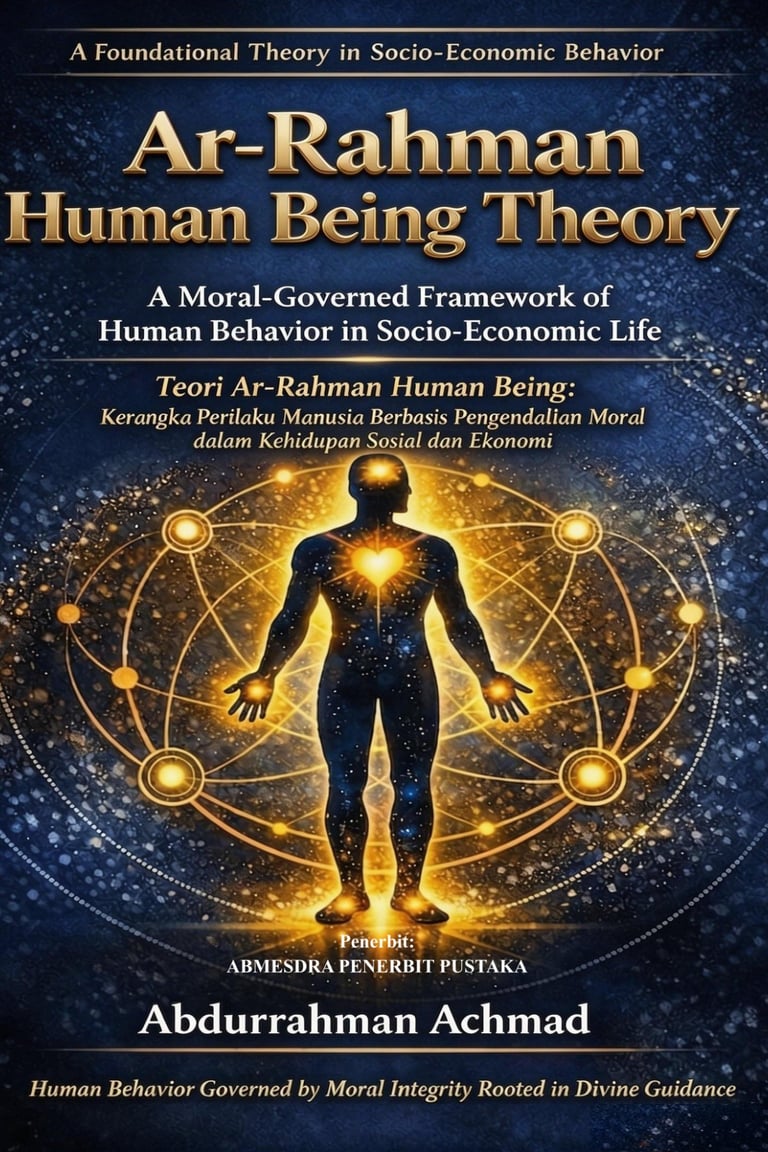
Ar-Rahman Human Being Theory: A Moral-Governed Framework of Human Behavior in Socio-Economic Life
ISBN: 9786340507829, KDT: Terdaftar dalam katalog nasional Perpustakaan Nasional RI
BUKU REFERENSI
Dr. ABDURRAHMAN ACHMAD, S.E., S.H., M.M.
SINOPSIS
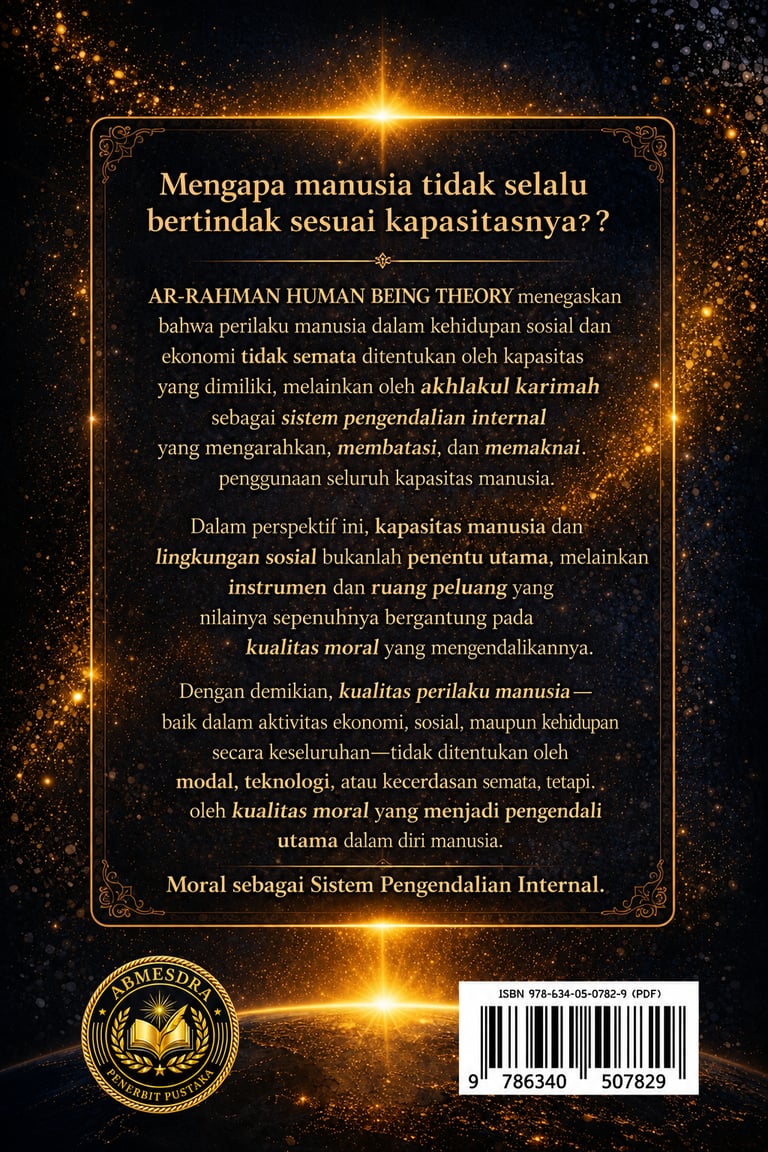
Ar-Rahman Human Being Theory merupakan sebuah kerangka teoretis yang menempatkan akhlakul karimah sebagai pusat pengendalian perilaku manusia dalam kehidupan sosial dan ekonomi. Buku ini mengintegrasikan secara sistematis tiga elemen utama, yaitu moralitas sebagai pengendali, kapasitas manusia sebagai instrumen tindakan, serta lingkungan sebagai ruang peluang yang dihadapi manusia.
Berbeda dengan pendekatan konvensional yang menitikberatkan pada rasionalitas dan kapasitas semata, teori ini menegaskan bahwa arah dan kualitas perilaku manusia ditentukan oleh kualitas moral internal yang mengendalikan penggunaan seluruh kapasitas yang dimiliki. Kapasitas seperti keahlian, pendidikan, kemampuan fisik, dan modal tidak memiliki arah intrinsik tanpa adanya pengendalian moral.
Dikembangkan melalui pendekatan filosofis, konseptual, dan empiris (termasuk pengujian berbasis SEM-PLS), buku ini menghadirkan suatu Moral-Governed Behavioral Framework yang menjelaskan bagaimana manusia bertindak dalam kehidupan sosial ekonomi.
Ar-Rahman Human Being Theory tidak hanya menawarkan kontribusi teoretis dalam ilmu sosial dan ekonomi, tetapi juga menjadi landasan konseptual dalam menjawab krisis moral modern, dengan menegaskan bahwa pembangunan manusia berbasis moral merupakan fondasi utama bagi terciptanya kehidupan sosial-ekonomi yang berkeadilan, berkelanjutan, dan berkeadaban.
Ukuran Buku : 21,6 cm x 27,9 cm
Jumlah Halaman : 117 Halaman
ISBN : 9786340507829
Katalog Dalam Terbitan (KDT) : Terdaftar
DAFTAR PUSTAKA
Achmad, A. (2022). The Existence of Micro and Small Businesses during The Corona Virus Pandemic (Covid-19) in The City of Makassar. International Journal of Innovative Science and Research Technology (IJISRT), 7(3), 665-668.
Achmad, A. (2026). Resource Based Business Resilience The Moderating Role of Akhlakul Karimah in The Ar Rahman Human Being Model. Economics and Business Journal (ECBIS), 4(3), 565–582. https://doi.org/10.47353/ecbis.v4i3.305.
Ariely, D. (2008). Predictably irrational. HarperCollins.
Aristotle. (2009). Nicomachean ethics. Oxford University Press.
Barney, J. (1991). Firm resources and sustained competitive advantage. Journal of Management, 17(1), 99–120.
Barney, J., Ketchen, D., & Wright, M. (2011). The future of resource-based theory. Journal of Management, 37(5), 1299–1315.
Becker, G. S. (1964). Human capital: A theoretical and empirical analysis. University of Chicago Press.
Becker, G. S. (1993). Human capital: A theoretical and empirical analysis with special reference to education (3rd ed.). University of Chicago Press.
Brown, M. E., & Treviño, L. K. (2006). Ethical leadership: A review and future directions. The Leadership Quarterly, 17(6), 595–616.
Chapra, M. U. (2000). The future of economics: An Islamic perspective. Islamic Foundation.
DiMaggio, P. J., & Powell, W. W. (1983). The iron cage revisited. American Sociological Review, 48(2), 147–160.
Duchek, S. (2020). Organizational resilience: A capability-based conceptualization. Business Research, 13, 215–246.
Friedman, M. (1953). Essays in positive economics. University of Chicago Press.
Haidt, J. (2012). The righteous mind: Why good people are divided by politics and religion. Pantheon Books.
Kahneman, D. (2011). Thinking, fast and slow. Farrar, Straus and Giroux.
Lengnick-Hall, C. A., Beck, T. E., & Lengnick-Hall, M. L. (2011). Developing a capacity for organizational resilience. Human Resource Management Review, 21(3), 243–255.
Maak, T., & Pless, N. M. (2006). Responsible leadership in a stakeholder society. Journal of Business Ethics, 66(1), 99–115.
McClelland, D. C. (1961). The achieving society. Van Nostrand.
Nekovee, M., & Pinto, J. (2017). Modelling corruption contagion in organizations. arXiv preprint.
North, D. C. (1990). Institutions, institutional change and economic performance. Cambridge University Press.
Nussbaum, M. C. (2011). Creating capabilities: The human development approach. Harvard University Press.
Putri, A. S. (2024). Analisis kegagalan koperasi Indosurya. Media Hukum Indonesia.
Rahayu, I. R. S. (2025). Kasus gagal bayar koperasi Indosurya. Jurnal Hukum Dinamika Ekselensia.
Rest, J. R. (1986). Moral development: Advances in research and theory. Praeger.
Sen, A. (1999). Development as freedom. Oxford University Press.
Shane, S., & Venkataraman, S. (2000). The promise of entrepreneurship as a field of research. Academy of Management Review, 25(1), 217–226.
Scott, W. R. (2014). Institutions and organizations: Ideas, interests, and identities. Sage Publications.
Scott, J. (2000). Rational choice theory. In G. Browning et al. (Eds.), Understanding contemporary society. Sage.
Schultz, T. W. (1961). Investment in human capital. American Economic Review, 51(1), 1–17.
Smith, A. (2007). An inquiry into the nature and causes of the wealth of nations. MetaLibri. (Original work published 1776)
Teece, D. J. (2007). Explicating dynamic capabilities. Strategic Management Journal, 28(13), 1319–1350.
Thaler, R. H. (2016). Behavioral economics: Past, present, and future. American Economic Review, 106(7), 1577–1600.
Treviño, L. K., Weaver, G. R., & Reynolds, S. J. (2006). Behavioral ethics in organizations: A review. Journal of Management, 32(6), 951–990.
Sumber Berita:
CNBC Indonesia. (2023). Kasus koperasi gagal bayar di Indonesia.
Neraca. (2025). Koperasi bermasalah dengan kewajiban Rp23,9 triliun.
Waspada.id. (2025). Akar masalah koperasi dan risiko tata kelola.
Format APA Style (7th Edition)
Achmad, A. (2026). Ar-Rahman Human Being Theory: A moral-governed framework of human behavior in socio-economic life. ABMESDRA Penerbit Pustaka.
Format Penulisan Lengkap
Achmad, Abdurrahman. (2026). Ar-Rahman Human Being Theory: A Moral-Governed Framework of Human Behavior in Socio-Economic Life. ABMESDRA Penerbit Pustaka.
Contoh Sitasi Dalam Teks
Sitasi Parentetik: (Achmad, 2026)
Sitasi Naratif: Achmad (2026)
PENULISAN SITASI